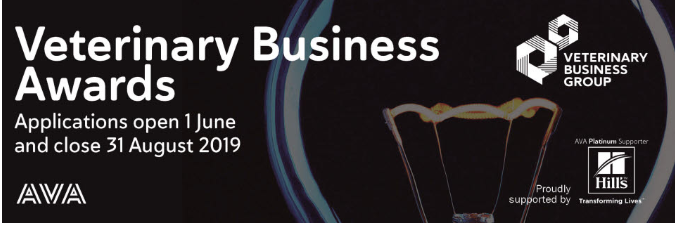
Veterinary Business Awards

Proudly supported by

Applications open 1 June
and close 31 August 2019

These awards offer a combined prize pool of more than $10,000 in continuing professional development, as well as the kudos that come from taking out Australia’s most prestigious veterinary business awards.

You can nominate yourself, your business or be nominated by an industry representative, other veterinary business professionals or your clients (members of the public). Privacy shall be maintained in relation to nominees.

Awards available

Each Award consists of:

  • Veterinary Business Group continuing professional development vouchers valued at $2,000
  • Hill’s Pet Nutrition continuing professional development vouchers or product vouchers valued at $1,500
  • Two registrations to the Veterinary Business Group Summit, including tickets to the Gala Dinner
  • A profile of the practice in AVA and Veterinary Business Group’s electronic communications
  • Framed certificate for display in your practice
  • A chance to present at the Veterinary Business Group Summit

Eligibility

Nominations will be accepted from any practice in Australia and the leaders of the business must be Veterinary Business Group members. Veterinary Business Thought Leader Award is also eligible for student members of the Veterinary Business Group.


Veterinary Business of the Year
(formerly Practice of Excellence Award)

An organisation that demonstrates outstanding performance across the 10 core competencies of veterinary business.

Competencies include:

  • Leadership
  • Change Management
  • Financial Management
  • Clinical Standards and Protocols
  • Human Resources & Industrial Relations
  • Strategic Planning
  • Ethics
  • Risk Management
  • Marketing
  • Technology
Requirements
  • An essay outlining how the veterinary business is outstanding in each of the core competencies (up to 300 words for each competency)
  • Two written references that speak to the outstanding nature of the veterinary business. These may be  from clients or other veterinary  business colleagues.

Veterinary Business Thought Leader

An individual that has challenged the status quo, stimulated industry debate or become a force for change in response to challenges facing veterinary business.

This award may relate to a journal article, published paper or digital content that advances veterinary business.

Requirements
  • Content piece
  • Two written references that speak to the significance of the content as a catalyst for change.

Veterinary Business Professional of the Year

An individual who is both technically excellent in the field of veterinary business, and who has made an outstanding service contribution to veterinary business over time.

Requirements
  • Current CV
  • Two written references that speak to the individual’s capability and contribution.

For Original Source please click here.

For more industry news please check out our website.

Find us on Social Media – Facebook, Instagram, LinkedIn and Twitter.

Along came Alongshan virus, a new tick-borne disease

Published on June 11, 2019

Author: Melvin Sanicas

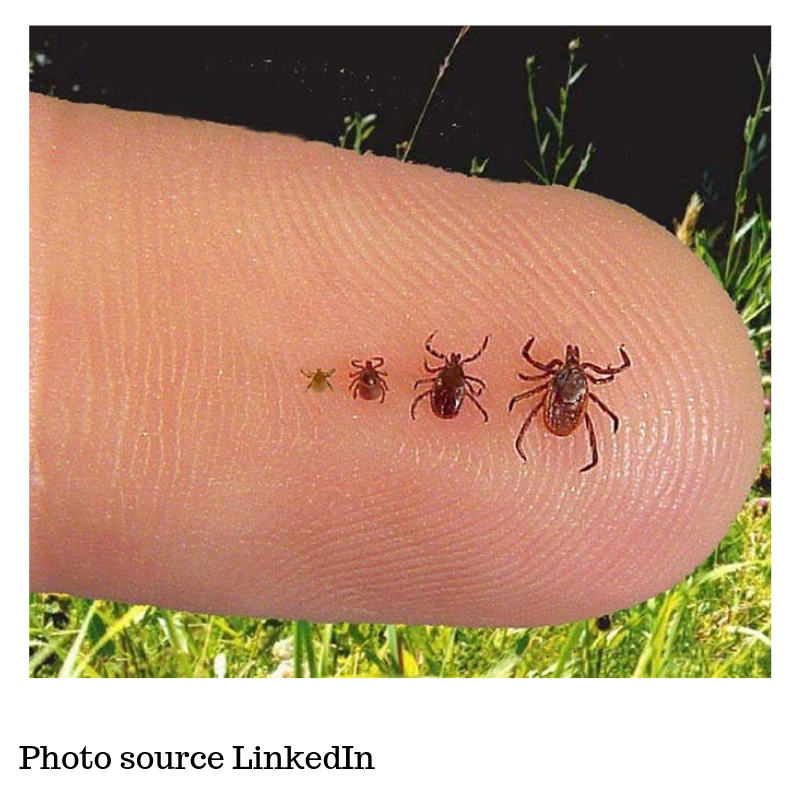
Tick-borne diseases, which afflict humans and other animals, are caused by infectious agents (viruses, bacteria, protozoa) transmitted by tick bites. As of 2016, 16 tick-borne diseases of humans have been identified, including Lyme disease, tularemia, babesiosis and Rocky Mountain Spotted fever.

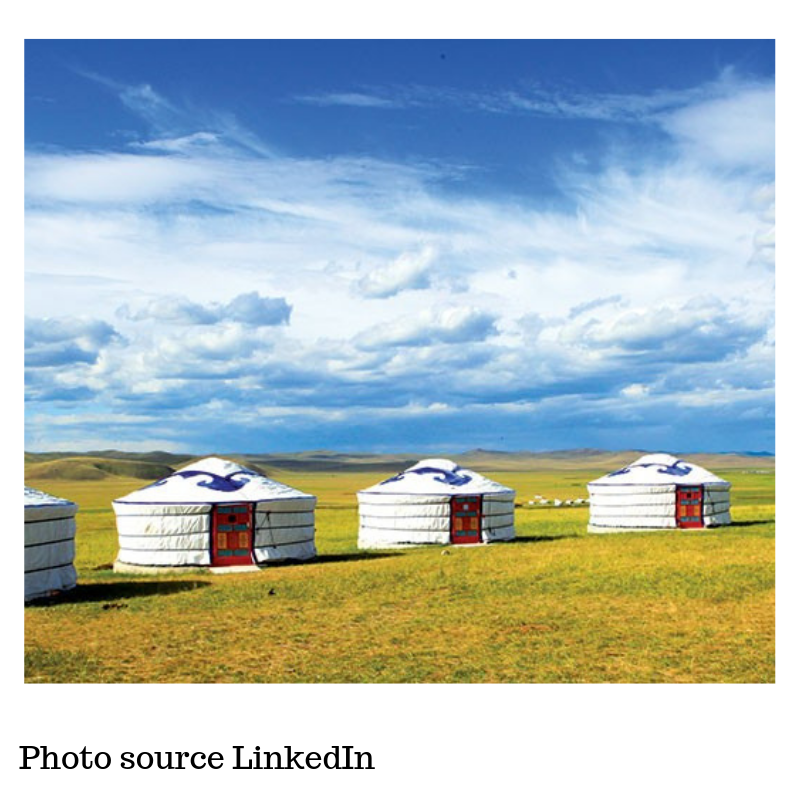
A group of patients in Inner Mongolia likely represent the first identified human cases of a new tick-borne illness — the Alongshan virus (ALSV). A description of ALSV, along with associated cases, was recently published in the New England Journal of Medicine. ALSV belongs to the jingmenvirus group in the flavivirus family. The first member of the group was described in 2014 and named the Jingmen tick virus (JMTV) because it was isolated from a tick in Jingmen, China.

In 2017, a 42-year-old woman (the index patient) presented to an Inner Mongolian hospital with a headache, fever, and history of tick bite. The woman showed signs of tick-borne encephalitis virus or TBEV but according to the study’s authors, “neither TBEV RNA nor antibodies against TBEV were detected.”

A total of 86 patients were eventually identified with similar symptoms. The patients were infected with an unknown segmented RNA virus, which the authors named ALSV. There were no deaths and all patients recovered with supportive care and the administration of antimicrobials and antivirals. However, 30 out of 86 (35%) patients experienced coma, which suggests ALSV can cause severe illness.

“Our findings suggest that ALSV may be the cause of a previously unknown febrile disease, and more studies should be conducted to determine the geographic distribution of this disease outside its current areas of identification,” the authors concluded. They noted the disease has only been found in Inner Mongolia an autonomous region of northern China and carried by Ixodes persulcatus ticks. Mosquitoes in the area, too, also purportedly carry the disease. It is not currently clear if patients are getting the illness exclusively from ticks or from mosquitoes.

New technologies such as next-generation sequencing have greatly accelerated the pace of discovery of new viruses in a wide range of hosts. In a related commentary, experts from the University of Texas Medical Branch at Galveston wrote, “The nature of ALSV, a unique virus in the family Flaviviridae with a vector that has a wide distribution, should warn us of its potential.”

ALSV is only one of the emerging pathogens that has recently been identified in China, in addition to Huaiyangshan banyangvirus (formerly SFTS virus) and Anaplasma capra. There will be more. The experts noted that a far more cost-effective way to understand the emergence of diseases and mitigate their outbreak is a proactive, real-time surveillance of human populations.

In summer months when tick season is at its height, it is recommended to check for ticks daily, especially under the arms, in and around the ears, inside the belly button, behind the knees, between the legs, around the waist, and on the hairline and scalp and shower soon after being outdoors.

Melvin Sanicas

Physician | Scientist | TED Educator | Writer

For Original Source please click here.

For more industry news please check out our website.

Find us on Social Media – Facebook, Instagram, LinkedIn and Twitter.

The world’s largest king penguin colony has collapsed, losing nearly 90 per cent of its population

Source: https://nationalpost.com/

The world’s largest king penguin colony has collapsed, losing nearly 90 percent of its population

The cause of the population collapse remains a mystery, with scientists speculating that climate fluctuations or disease could be to blame


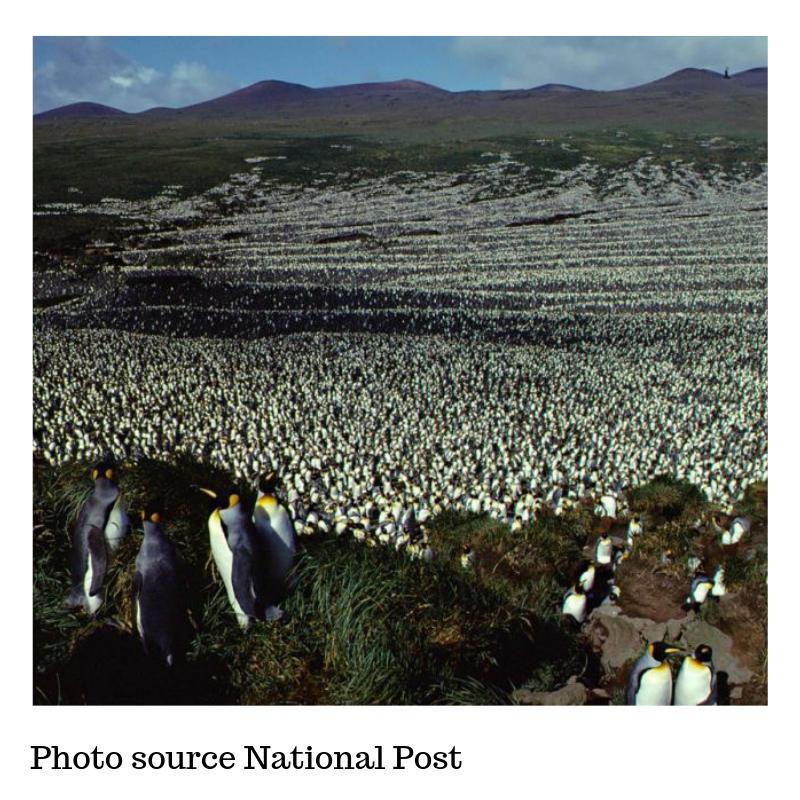
This handout photo taken in 1982 and released on July 30, 2018 by the French National Centre for Scientific Research shows a two-million-strong king penguin colony on Ile aux Cochon.
HENRI WEIMERSKIRCH via AFP/Getty Images

The biggest colony of king penguins on the planet has collapsed, with nearly 90 per cent of the population vanishing since the 1980s, ecologists said.

The colony was first discovered in the Sixties on Ile aux Cochons, also known as Pig Island, in the southern Indian Ocean, between Madagascar and Antarctica. At its peak it contained two million birds and 500,000 breeding pairs, but new satellite images have shown an empty landscape, in which 88 per cent of the colony appears to have vanished.

Although nobody has set foot on the island since 1982, photographs taken from a helicopter during a recent flyover show that there could be just 60,000 breeding pairs left, and scientists fear the decline will continue.

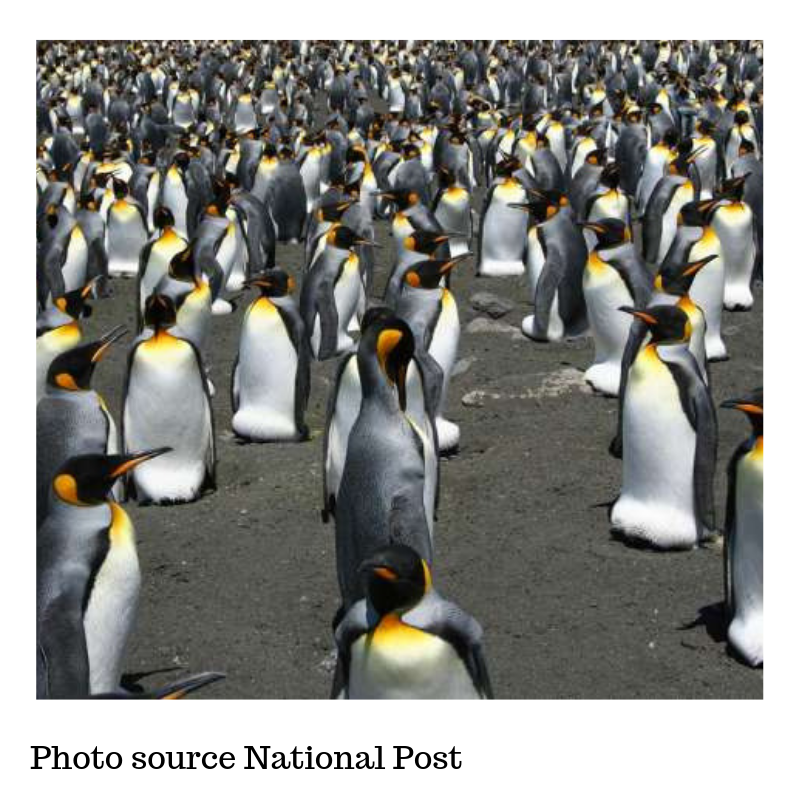
King Penguins from the Possession Island in the Crozet archipelago. CNRS/IPEV/CSM/CELINE LE BOHEC via AFP/Getty Images

“It is completely unexpected, and particularly significant since this colony represented nearly one third of the king penguins in the world,” said research leader Dr. Henri Weimers-kirch, an ecologist at the Centre for -Biological Studies in Chize, France.

King penguins do not make a nest, but lay one egg at a time and carry it around on their feet. Parents take turns incubating the egg, switching every couple of weeks over two months.

They are currently listed as a species “of least concern” on the Red List of Threatened Species but that now may be re-evaluated after the dramatic loss.

The cause of the population collapse remains a mystery, with scientists speculating that climate fluctuations or disease could be to blame. In 1997, a particularly strong El Nino weather event pushed the fish and squid on which king penguins depend further south, beyond their foraging range.

Researchers plan to mount future field studies on the island to test animals for infection and so see if disease may be wiping out the birds.

The latest findings are published in the journal Antarctic Science.

For Original Source please click here.

For more industry news please check out our website.

Find us on Social Media – Facebook, Instagram, LinkedIn and Twitter.

Sustainable animal agriculture

Source: https://www.bva.co.uk/

BVA position on UK sustainable animal agriculture

Sustainable animal agriculture can be defined as animal agriculture* carried out in a way that meets the needs of the present without compromising the ability to meet the needs of the future. Sustainable animal agriculture should be undertaken in a way that is environmentally, ethically and economically acceptable for consumers, producers and wider society.

The veterinary profession has a key role to play in advancing the roles and status of animals within sustainable animal agriculture and ensuring that the highest standards of health and welfare for production animals are maintained and recognised as a key sustainability objective.

*Where animal agriculture includes aquaculture and gamebirds.

As part of this, animal health and welfare should not be unnecessarily compromised to address human need and in order to be considered sustainable, agricultural systems must work towards the positive health and welfare of all farmed animals raised within them.

Our specific recommendations to enable the veterinary profession and other key stakeholders to contribute to the sustainable animal agriculture agenda centre on eight areas:

  • Animal health and welfare as a key sustainability objective
  • Sustainable resource management to protect and conserve species, habitats and biodiversity
  • The role of the veterinary profession from farm to fork
  • Welfare outcome assessment, including at slaughter
  • Emerging trends: breeding, technology and innovation
  • Innovative whole farm management systems to deliver both environmental and animal health and welfare public goods
  • Alternative sources of protein
  • Consumers and sustainable consumption of animal-derived products

Read the BVA position on UK sustainable animal agriculture in full (354 KB PDF)

Read the BVA position on UK sustainable animal agriculture – Executive summary (178 KB PDF)Sustainable consumption – Eating less and better

BVA is promoting the benefits of sustainable consumption and the concept of “less and better”.

Eating “less and better” sees some citizens reduce consumption of animal derived products, whilst maintaining proportional spend on high animal health and welfare products.

To help consumers make purchasing choices that promote high animal health and welfare and align with their own ethical and budgetary priorities BVA has produced:

These resources form part of the BVA #ChooseAssured campaign. We want to encourage the veterinary profession and the wider public to #ChooseAssured by purchasing animal-derived products that are farm assured. Through the campaign we hope to raise awareness of the great work of the UK’s farm assurance schemes and the crucial work of vets within the schemes to safeguard high animal health and welfare.

Sustainability and the veterinary profession action plan

89% of vets told us that they think the veterinary profession should play a more active role in the sustainability agenda .

As an evidence-based, scientific profession there are a multitude of ways that vets can contribute to the sustainable animal agriculture agenda.

In the BVA sustainability and the veterinary profession action plan, BVA sets out how vets can contribute to sustainable animal agriculture at individual, practice and association levels. We’d encourage all vets, whatever their area of work, to take a look and see what positive influences you could make with just a few simple actions.

Individuals

  • Creating farm health and welfare plans to prevent and control disease, increasing efficiency and welfare
  • Using benchmarking tools to monitor and reduce, for example, lameness and antibiotic use
  • Advising on and promoting higher welfare systems at times of farm investment, such as building redesign
  • Always taking a “3Rs” (Replacement, Reduction and Refinement) approach when advising on mutilations – aiming to prevent the need for procedures and using modern analgesia protocols when the procedures are absolutely necessary
  • Considering eating “less and better” by reducing consumption of meat while maintaining proportional spend so that this spend is directed towards higher health and welfare products.
  • Promoting the value of farm assurance schemes. The BVA position on farm assurance schemes and the BVA #ChooseAssured: UK farm assurance schemes infographic can be used as reference tools when talking to clients or other members of the public about the value of farm assurance schemes and how they can choose ethical and sustainable animal food products.
  • Upholding existing legislation with regard to protecting public health (the prevention of zoonotic disease), food safety and food hygiene and reporting and monitoring food chain information.
  • Safeguarding and promoting animal welfare at slaughter and welfare during transport in line with existing legislation

Practices

  • Creating practice policies on mutilations based on the “3Rs” (Replacement, Reduction, Refinement) and modern analgesia protocols
  • Distributing educational materials (eg. The BVA position on farm assurance schemes and BVA #ChooseAssured: UK farm assurance schemes infographic to help clients make informed and ethical food choices (NB this can be undertaken by all practices, eg. companion and equine, as well as farm practices)
  • Creating and communicating a practice food procurement policy, to be used, for example, when providing animal-derived food to hospitalised patients, or when selecting venues for staff meetings and gatherings. The BVA food procurement policy (122 KB PDF), incorporating sustainability of harvest, animal health and welfare, fair conditions for producers and food miles, could be adopted for this purpose
  • Offering visits to local politicians and key opinion leaders, to discuss the challenges of future animal agriculture and to advocate the best interests of animals when considering solutions

Associations

  • Raising awareness of the challenges facing the global food system, providing thought leadership, opportunities for informed debate and consistently advocating the importance of animal health and welfare as a sustainable development goal
  • Considering the interests of all stakeholders when developing policy related to animal agriculture and ensuring that primary consideration and weight is given to the welfare interests of animals
  • Promoting the practical experience, scientific expertise and ethical reasoning abilities of veterinary surgeons to policy makers involved with the future of animal farming
  • Collaboratively developing policy on welfare problems affecting farmed animals, as mandated by the BVA Animal Welfare Strategy: Vets speaking up for animal welfare
  • Developing and signposting evidence-based information to citizens on farm assurance schemes, to enable them to make informed, sustainable and more ethical purchases

For Original Source please click here.

For more industry news please check out our website.

Find us on Social Media – Facebook, Instagram, LinkedIn and Twitter.

How to tell if you’re close to burning out

For Original Source please click here.

For more industry news please check out our website.

Find us on Social Media – Facebook, Instagram, LinkedIn and Twitter.