Unleashed Online Conference – Dr Gerardo Poli

This image has an empty alt attribute; its file name is unleashed-conference-2-1.png

I am hosting the “Unleashed Online Conference” which focusing on sharing the – often under taught – skills and tools that when combined with clinical knowhow the participants will be able to take things to the next level in their veterinary journey.

Conference 13-14 July from 8:30am Brisbane time

8 Speakers, across 2 days including myself, Dr Alex Hynes, Dr Brooke Schampers, Dr Hubert Hiemstra and Dr Nadine Hamilton plus special guests Anthony Laye who is a behaviour and confidence expert, Dr Shibly Mustapha and Sarah Pallett who is my marketing guru.

This image has an empty alt attribute; its file name is photo-1.png

This image has an empty alt attribute; its file name is photo-2.png

This image has an empty alt attribute; its file name is photo-3.png

14 hours of Interactive Workshops

Questions & Answers with Expert Panel

Free access to :

Pre conference short course

Digital workbook

Digital swag bag

Tickets from $57 AUD 

Live tickets get you access to live giveaways, the expert Questions and Answers sessions and additional free resources in member area. 

Plus 3 months free CPD with veterinary education provider Improve International.  Live attendees will have all conference and Questions and Answers videos in their member area to watch again at own pace and time.

The topics we are covering include:

  • Achieving clarity: what do you want to achieve and how to get it
  • Work-life-study balance – what it means to you & how do you achieve it
  • Developing confidence
  • Client communication – creating win-win client interactions
  • Self-awareness & valuing your knowledge & skills
  • Successful transitioning when stepping up into roles
  • Building resilience to help you bounce back from adversity
  • Developing influence and impact as a veterinarian
  • Top tips from the Vet Vault Podcast Mentors

For more information and to purchase tickets please click here.

Special Offer for For VeterinaryCareers.com.au Candidates.
If you register as a Candidate you will get 15% off tickets.
To register as a Candidate please click here.

Love Your Pet Love Your Vet – Dr Nadine Hamilton

Love Your Pet Love Your Vet – Dr Nadine Hamilton

“Veterinarians have one of the highest rates of suicide – approximately four-times the national average (or around 1 suicide every 12 weeks).  Our founder, Author and Psychologist Dr Nadine Hamilton, completed doctoral research into veterinarian wellbeing and is passionate about raising awareness of this serious issue.  She has recently published a self-help book based on her research and intervention program called “Coping with Stress and Burnout as a Veterinarian” to help address the issues.

In 2018 we partnered with Royal Canin Australia to raise awareness within the community of the factors contributing to the alarming rate of burnout and suicide in veterinarians, as well as reduce the stigma in veterinary professionals seeking help, and provide support in helping them regain their wellbeing and quality of life.  Our initial campaign was so successful that Dr Nadine registered Love Your Pet Love Your Vet as a charity to enable us to extend the work we are doing for the veterinary community.”

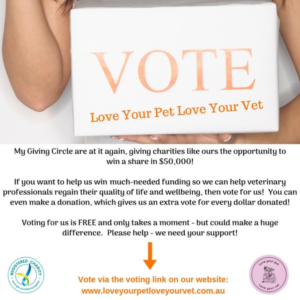
Will you make a tax-time donation before June 30th and help Love Your Pet Love Your Vet share in $17,000 worth of grants at My Giving Circle?

Please help if you can by making a donation, big or small at the “My Giving Circle” link.

For Love Your Pet Love Your Vet website please click here.

For more industry news please check out our website.

Find us on Social Media – Facebook, Instagram, LinkedIn and Twitter.

PhD position in a project about weight carrying ability in Icelandic horses – Phd student, research subject

Swedish University of Agricultural Sciences

Ref SLU ua 2019.2.5.1-2126

Department of Anatomy, Physiology and Biochemistry

The Department of anatomy, physiology and biochemistry conducts research and education on the structure and function of animals. We work primarily with food producing animals, sports- and companion animals and research animals, but also insects, spiders and wildlife. Our teaching on bachelor- and master levels in anatomy, histology, physiology and biochemistry is pursued mainly within SLU’s veterinary programme and bachelor and master programmes in animal science, but also in independent courses. Our research and doctoral education span over several topics including the molecular and cellular mechanisms of animals to the structure and function of the whole animal, and how animals are affected by physical work, production stress, diseases, husbandry and environmental factors. The department is located in VHC and have around 50 employees.

Description:

The Icelandic horse is popular and can be found in more than 30 countries. Compared to other breeds commonly ridden by adults, it is small and there has been a discussion regarding how much weight this horse can carry. However, the knowledge is limited and scientific studies are scarce. There is therefore a need to increase the knowledge. The aim of this project is to develop a system based on an exercise test and physiological and anatomical data that can accurately describe a horse’s current weight carrying ability. This knowledge can be used by tourist companies, riding schools and also as an objective description when horses are for sale. The project is a collaboration between SLU and Hólar University College on Iceland.

Duties:

To perform PhD studies and together with the research group and supervisors plan, collect, analyse, prepare, write and present data from the studies performed. The PhD shall participate in teaching and contribute to the development of the department, the faculty and the university. Substantial parts of the practical research will be performed at Hólar University College on Iceland. Communication with the horse industry may also be relevant.

Qualifications:

The applicant shall have a master degree in animal science, veterinary medicine, animal agronomy or equivalent. The applicant shall have documented experience of handling of horses. Experience of scientific or practical work with relevance for the area or industry is desired. The applicant shall be skilled in working in a team as well as independently. Good knowledge in written and spoken English is required. The applicant shall be prepared to learn Swedish. Personal qualities are of high importance as well as references.

Place of work:

SLU Uppsala, Sweden and Hólar University College, Iceland.

Forms for funding or employment:

The position is 100 % for 4 years

Starting date:

According to agreement.

Application:

We welcome your application no later than 2019-06-27, use the button below.

The application shall not be not more than one page (A4), in addition to CV and authenticated merits.

A person has basic eligibility for third cycle education if he or she has taken a second cycle qualification or has completed course requirements of at least 240 higher education credits, including at least 60 higher education credits at second cycle education. Upper secondary school grades equivalent to English B/English 6 are a basic requirement.

Selection among applicants meeting the requirements is made with reference to written application including curriculum vitae, copies of degrees and transcripts of academic records, one copy of the dissertation for masters or undergraduate degree, a list of at least two references familiar with the applicant’s qualifications, certified knowledge of the English language and an interview.

Please observe that applicant/s chosen to participate in an interview shall hand in certified true copies of certificates, diplomas and transcripts from previous studies at an internationally recognized higher education institution (university or university college) and transcripts in connection to the interview. If the applicant is a foreign citizen we require a certified copy of the page in your apssport with your personal data and phograghy.

Read about the PhD education at SLU at www.slu.se/en/education/postgraduate-studies/

Academic union representatives:

https://internt.slu.se/en/my-employment/employee-associations/kontaktpersoner-vid-rekrytering/

The Swedish University of Agricultural Sciences (SLU) develops the understanding and sustainable use and management of biological natural resources. The university ranks well internationally within its subject areas. SLU is a research-intensive university that also offers unique degree programmes in for example rural development and natural resource management, environmental economics, animal science and landscape architecture.

SLU has just over 3,000 employees, 5,000 students and a turnover of SEK 3 billion. The university has invested heavily in a modern, attractive environment on its campuses in Alnarp, Umeå and Uppsala.

www.slu.se

SLU is an equal opportunity employer.

Contact person

Anna Jansson

professor

018-672106

fornamn.efternamn@slu.se

Carl-Gustaf Thulin

prefekt

070-5645358

fornamn.efternamn@slu.se

For more information please click here.

For more information on Continuing Education in your Veterinary Career please refer to our website.


University of Tasmania – Ethics Committee

Ethics Committee

Job no: 493572
Work type: Full time
Location: Hobart
Categories: Legal & Compliance, Strategy, Community & Engagement

The University of Tasmania is seeking expressions of interest for Ethics Committee Membership. Ethics Committees play a crucial role in the responsible conduct of research—this is an exciting opportunity for members of the community to support research in Tasmania.

Social Sciences Human Research Ethics Committee:

  • Category B Member: a person who has no affiliation with the institution and does not currently engage in medical, scientific, legal or academic work.
  • Category D Member: at least one person who performs a pastoral care role in a community, for example, an Aboriginal elder, a minister of religion.
  • Category E Member: a lawyer who is not engaged to advise the institution.

Health and Medical Human Research Ethics Committee:

  • Category D member: a person who performs a pastoral care role in a community, for example, an Aboriginal elder, a minister of religion.

The Human Research Committees are constituted to ensure that all research is carried out in an ethical manner and in accordance with theNational Statement on Ethical Conduct in Human Research 2007 (Updated 2018).

Further information regarding human research ethics at the University of Tasmania is available from http://www.utas.edu.au/research-admin/research-integrity-and-ethics-unit-rieu/human-ethics/human-research-ethics-review-process/membership-of-a-human-research-ethics-committee

Animal Ethics Committee:

  • Category D member: a person not employed by or otherwise associated with the institution and who has never been involved in the use of animals in scientific or teaching activities, either in their employment or beyond their undergraduate education.

The Animal Ethics Committee is constituted to ensure that all research is carried out in an ethical manner and in accordance with the   Australian Code for the Care and Use of Animals for Scientific Purposes (8th Edition 2013).

Further information regarding animal ethics at the University of Tasmania is available from http://www.utas.edu.au/research-admin/research-integrity-and-ethics-unit-rieu/animal-ethics/animal-ethics-committee

The appointments will be for a two-year period by mutual agreement. Applicants are advised that a substantial amount of reading is required in preparation for attendance at monthly meetings.

Expressions of interest for the above member vacancies are sought by 10 May 2019. Interested applicants are encouraged to contact Adele Kay, Manager, Research Integrity and Ethics Unit. (03 6226 7479  adele.kay@utas.edu.au )

The University of Tasmania seeks to support and encourage membership applications from Aboriginal and Torres Strait Islander people.

Please do not apply online.

Advertised: Tasmania Standard Time
Applications close: Tasmania Standard Time


For more information click here.

Linking spatial movements and social contacts to understand transmission of Tasmanian devil facial tumour disease.

University of Tasmania – Research Project

Linking spatial movements and social contacts to understand transmission of Tasmanian devil facial tumour disease.

Closing Date

30th May 2019

Applicants should contact the primary supervisor, and submit their Expression of Interest (EOI) and Application as soon as possible.

The Research Project

Tasmanian devils are threatened by transmissible cancer, devil facial tumour disease (DFTD), which has spread to almost their entire geographic range and has caused more than 90% population decline. A gap in knowledge for wildlife diseases globally, and DFTD specifically, is how the spatial connectivity between individuals at large landscape scales maps onto the social contacts between individuals at a local scale that lead to transmission. To understand how the disease spreads across the landscape requires integrating data on who-contacts and bites-who in the population with finescale information about how individuals move at landscape-scale throughout the year.

The project integrates spatial and social data to understand disease transmission and spatial spread. The field project involves placing collars on the adult population of devils at field sites with different histories of time since disease outbreak. The collars will record both the location of the animals and the identity of any other collared devils that come within close range. The field sites are in remote but beautiful locations in Tasmania. The statistical methods will involve constructing social networks and analysing movement data. The project is part of an international, transdisciplinary research program on evolution in the devil—DFTD host—pathogen system involving ecologists, epidemiologists and genomicists at the University of Tasmania, Griffith University, Washington State University and the University of Idaho, funded by a grant from the US National Institute of Health/National Science Foundation.

Eligibility:

The following eligibility criteria apply to this scholarship:

  • The scholarship is open to Australian and New Zealand (domestic) candidates and to International candidates.
  • Research must be undertaken on a full-time basis.
  • Applicants must already have been awarded a first-class Honours degree or hold equivalent qualifications or relevant and substantial research experience in an appropriate sector.
  • Applicants must be able to demonstrate strong research and analytical skills.

Candidates from the following disciplinary backgrounds are encouraged to apply.  Knowledge and skills that will be ranked highly include:

  • A good understanding of the field of ecology
  • High level quantitative skills
  • Ability to work as part of an interdisciplinary research team
  • Proven ability to work individually in remote locations including supervising volunteer field assistants
  • Current driving licence, prefer manual and 4WD experience

Application Process

Applicants who require more information or are interested in this specific project should first contact the listed Supervisor. Information and guidance on the application process can be found on the Apply Now website.

Applicants should send a CV and Experession of Interest (one page maximum) to A/Prof Menna Jones before 30th May 2019

Information about scholarships is available on the Scholarships webpage.

More Information

Please contact Menna Jones for more information about this project, or take a look at A/Prof Menna Jones’s research profile here.

For more information please click here.