Fully Funded Commonwealth Scholarships | MSc Veterinary Epidemiology and Public Health and the MSc Livestock Health and Production | Royal Veterinary College | University of London

Applications close: 20 June 2018 – 23:59 (BST).

Commonwealth Scholarships are available for a number of University of London programmes by distance learning:

  • MSc Veterinary Epidemiology and Public Health (RVC)
  • MSc Livestock Health and Production (RVC)
  • MA Refugee Protection and Forced Migration Studies (SAS)
  • MSc Clinical Trials (LSHTM)
  • MSc Demography and Health (LSHTM)
  • MSc Epidemiology (LSHTM)
  • MSc Infectious Disease (LSHTM)

These full fee-waiver awards are for residents of developing Commonwealth countries (see below for details).

You apply for these courses through the University of London. For scholarship applications, please follow only the specific directions below.

Applications for these scholarships are currently open.

A total of nine scholarships for the MSc Veterinary Epidemiology and Public Health and the MSc Livestock Health and Production are available.

You must be a national of a qualifying Commonwealth country and hold the standard entry requirements for your preferred MSc course (including any English language requirements).

Qualifying countries

  • Bangladesh
  • Cameroon
  • Ghana
  • Guyana
  • India
  • Kenya
  • Kiribati
  • Lesotho
  • Malawi
  • Mozambique
  • Nigeria
  • Pakistan
  • Papua New Guinea
  • Rwanda
  • Samoa
  • Sierra Leone
  • Soloman Islands
  • Sri Lanka
  • Swaziland
  • Tanzania
  • Tuvalu
  • Uganda
  • Vanuatu
  • Zambia

Source: Commonwealth Scholarships | University of London 

The Australian Veterinary Association Annual Conference, 13-18 May 2018  Brisbane, Queensland

The AVA Annual Conference is the nation’s premier veterinary event, covering all fields of veterinary science and in 2017 brought together over 920 veterinary professionals and 115 exhibitors.

We hope you will join us for the 2018 AVA Annual Conference, 13-18 May 2018  Brisbane, Queensland

Why visit?

why-visitwhy-visitwhy-visit


For all exhibition enquiries please email events@ava.com.au


Source: AVA Conference | Your veterinary profession

Online Event – Veterinary Careers – Quarterly Career Planning Seminar! Wed 9 May 2018

Our next Career Planning Seminar is happening on 9 May 2018! Set your goals & get started on creating the career that you want!

Our Guest Speaker at this event is Tim Dyke, an inspirational Australian Veterinarian who has worked as a veterinarian to academic to government senior executive to leadership coach (who said a veterinary degree was limiting?). Tim will speak to us on:

‘Using Veterinary Expertise in a VUCA world…’

This 3 hour session will help centre and focus your career goals and the aim of the session is that you come away with a plan to get you there….

Cost: $55 AUD

Date: Wednesday 9 May 2018, 9.30am GMT+1 (London) and 6.30PM AEST (Sydney) – 3 hour event

What have your colleagues have to say about the session:

  • “I really enjoyed the session – gave me clarity in what I want from my career and ideas on how to make it happen”
  • “This session was invaluable to me to start to organise my goals and career aspirations. It came up exactly at the right time when I was in a position where I was sure how to proceed with ranking and sorting my interests and plans.”
  • “Would absolutely recommend this program to anyone who wants to explore different interests within the veterinary industry outside the normal GP in a clinic role but also if people are interested in career coaching and planning.”

Please follow THIS LINK to book your seat NOW! (https://theruralwoman.com.au/product/veterinary-careers-quarterly-career-planning-seminar/ )

Love Your Career!

Emma

Advancing ecological modelling for the prediction of emerging infectious diseases – CSIRO, Canberra

Free Symposium

Tuesday 1 May 2018, CSIRO Discovery Theatre, CSIRO Black Mountain

  • 9.00am – 5.00pm

North-science Road, Acton ACT, Get Directions

About the symposium

This symposium will cover some of the most advanced global and national research on factors associated with the risk of emergence of infectious diseases.

The symposium will also explore how mitigating this risk requires careful consideration of interactions between key goals of the United Nations Agenda for Sustainable Development: human health, biodiversity conservation, climate change mitigation and food security.

Emerging infectious diseases such as Zika, Ebola, H1N1 and SARS have dramatic impacts on human health and global economies, with millions of deaths each year and billions of dollars spent to control outbreaks.

The vast majority of recent emerging infectious disease events were caused by zoonotic (animal) pathogens, most of which originated in wild species.

Preventing future zoonotic disease emergence is a cost-effective strategy to anticipate and prevent disease spread, but this requires modelling a number of interacting factors that influence disease emergence risk.

Ecological modelling is essential in this context, given the strong links between expansion of humans and livestock into biodiversity hotspots and the risk of disease emergence, especially in tropical countries.

Structure

Dr Paul Bertsch, Acting Director Land and Water Business Unit (CSIRO), will open the meeting, followed by a keynote address from Dr Peter Daszak, President of EcoHealth Alliance, USA. Dr Daszak’s research has been instrumental in identifying and predicting the impact of emerging infectious diseases across the globe.

A series of presentations will explore more in-depth the various aspects related to disease emergence prediction and the relation with sustainable development, followed by open discussions with the audience.

Speakers for these presentations include: Dr Michelle Baker (CSIRO), Dr Simon Ferrier (CSIRO), Dr Cadhla Firth (University of Melbourne), Ms Cecile Godde (CSIRO), Dr Mario Herrero (CSIRO), Prof Raina MacIntyre (University of NSW), Dr Anna Okello (ACIAR), Dr Mark Stafford-Smith (CSIRO), Dr Carlos Zambrana-Torrelio (EcoHealth Alliance, USA).

A series of early career researcher speed talks and open discussion session will conclude the day.

Source: Advancing ecological modelling for the prediction of emerging infectious diseases – CSIRO

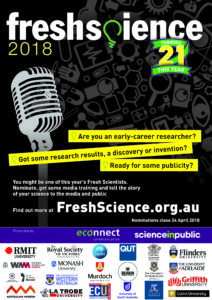
Nominations for Fresh Science 2018 are now open!! | Fresh Science

Nominations for Fresh Science close at midnight on Tuesday 24 April.

Have you got some interesting research results, a discovery or invention, still early-career and curious about how to get publicity for it?

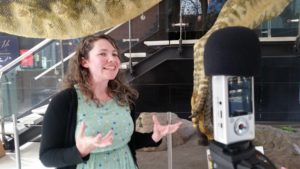
Consider nominating for Fresh Science – a national competition that finds researchers with discoveries, helps them find the key, compelling ‘story’ in their research and then puts them in the spotlight, showcasing them to the public and the media.

How to nominate

Nominations are made via an online form.

We recommend drafting your answers offline before uploading them into the online form. You can see what questions we are going

to ask by downloading a copy of the nomination form.

 You can also look at the stories of last year’s Freshies to see what we are looking for.

Nominations for Fresh Science close at midnight on Tuesday 24 April.

Spread the word

 We know most nominations from early-career researchers come because they’ve been encouraged by a their colleagues or supervisors. So make sure you give any great EMCRs you know a tap on the shoulder.

Need to know more?

Why nominate?

Get some media training. Find your voice. Learn how to tell your research in a compelling way be it to a journalist, politician or philanthropist. Practice being interview by journalists and be a part of the media landscape.

Have some fun at the pub. Take the spotlight and practice your new communication skills in front of a small audience.

Get your profile online with other Fresh Scientists.

Perhaps get into the media with one story per state written up as a press release and sent out to the media. Fresh Science offers one researcher per state the potential for substantial media exposure. In previous years our Fresh Scientists have attracted national and international interest resulting in hundreds of media stories in Australia and overseas.

Inspire the next generation of scientists by getting your story out and, in some states, talking directly with school students.

What does it involve?

A short painless nomination form filled out online. We ask you to explain your research briefly and provide evidence of peer review.

If selected, you will take part in:

  • a one-day media and communication training course with practice interviews
  • an evening event where you get to practice presenting your results in an understandable and fun way
  • In some states, we hold a schools forum where you will present for five minutes and take questions.
  • As part of Fresh Science we will write and publish a short, media-ready profile on you. See previous stories.
  • We will select one story per state to be written up as a press release and sent out to the media. See previous stories in the news.

Eligibility

We are looking for:

  • Early-career researchers. Age per se is not a criterion, but you must have completed your PhD (if you have one) no more than five years ago. If you’re earlier in your career, that’s fine.
  • Researchers currently working in Australia and preferably for work done in Australia.
  • Research which has produced peer-reviewed results i.e. you have a discovery, invention, patent etc.
  • Research which is currently being undertaken, or has been published/concluded since January 2016.
  • Research that is newsworthy but has not had significant media coverage.
  • Researchers who can demonstrate, through the nomination form, some ability to present your research to a lay audience in a clear, interesting and informative way.

Your research must be cleared for public and media presentation. You may need to consult with your collaborators and commercial partners before nominating.

You may represent a research team if you have played a substantial role in the research and can act and be named as spokesperson. Only one member of any particular research team will be invited to participate in Fresh Science.

Source: Nominate | Fresh Science