What’s your Management STYLE?

This week I have been doing Management Systems Leadership Training and a day and a half of it was teaching us to use the DiSC method of personality profiling – Have you heard of it? I highly recommend it to anyone who is or who has to deal with another human being – particularly those of us in the veterinary field who deal with an array of people throughout our day.

As professional vets we constantly deal with bosses, employees, colleagues and clients or stakeholders of various sorts – and with each of them our  personality interacts somehow with theirs. I remember from my practice days, on occasion, being totally stumped by someone’s responses to a situation – and now I know that I can use this tool to help give insight into the mystery that is “people”.
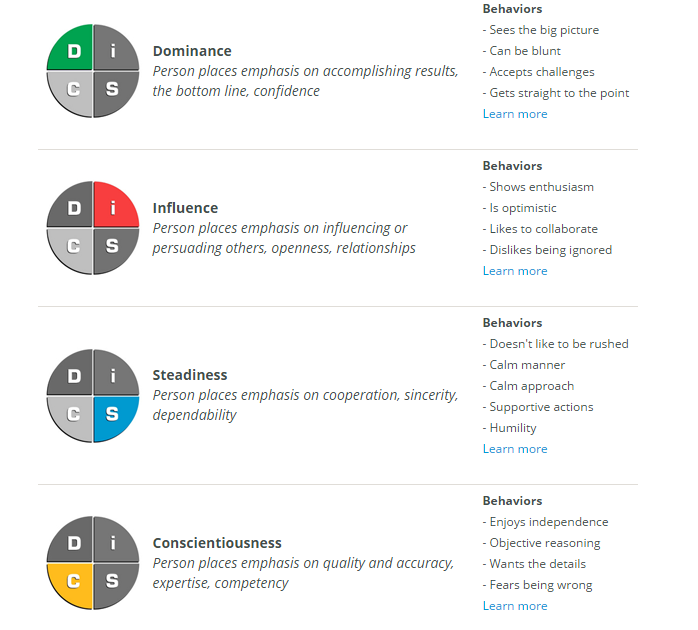
DiscDiSC has 4 primary personality STYLES and every person is a mix of one to 4 of these, and knowing this about yourself and others can really help you to understand the drivers at play behind behaviors seen in different relationships. There are 2 DiSC profiles – one for the workplace and a slightly altered one for when you are the Manager – and the management one is the one I have done this week.

A quick rundown of the four primary personality STYLES in the Management DiSC :
1. Dominance: Direct, results-oriented, firm, strong-willed, forceful
2. Influence: Outgoing, enthusiastic, optimistic, high-spirited, lively
3. Steadiness: Even-tempered, accommodating, patient, humble, tactful
4. Conscientiousness: Analytical, reserved, precise, private, systematic.

Any of these sound like you? Any two of these sound like you?

Some more factors in the disc profiling are some of the drivers of a personality, these help locate your primary STYLE, and are:

a. A high need for control OR A low need for control
b. A low need for affiliation OR A high need for affiliation (interaction with others)
c. Someone sees the environment as unfavorable OR Someone seeing the environment as highly favorable
d. Sees them Self as more powerful than the environment OR Sees them Self as less powerful than the environment.

How did you go? The general guide is for the 4 factors above:

a. D/i v C/S

b. D/C v i/S

c. D/C v i/S

d. D/i v C/S

I am a high iD which makes me now understand why my husband calls me a whirlwind and sometimes struggles to keep up (sorry darlin’).

All the enthusiasm of the i has me constantly dreaming up new big (sometimes wacky) ideas, talking him or others into it like its the best thing in the world – as I see the environment is favorable and I believe I can exert influence on the environment and often then I getting distracted with the next new bright shiny idea and a little bored in nutting out all the detail. The D in me has a need for control – and now I understand this I can hear hubby saying ‘just do it your way then…. (sigh)’ and now I can understand more of why this has happened more than once.

However being an iD does not stop me from functioning in the other 2 spaces, I work in Government for goodness sake – not exactly a Google-like-environment! My ‘i’ and a lot of my ‘D’ is parked each day before I enter the huge grey building, as I like to call it, and although my smile is never dampened (or rarely – and that is another blog!) my behavior is in accordance with the big grey building rules. Steady and thorough, I work systematically through things and limit my exuberant ideas to what might help make my boss look good and progress the work of our Division.

So what is DiSC then you might say? If someone can be all four – does it matter and is it real? The difference between living in the D or i or S or C space is that one or two of these come naturally to a person. One or two of them energize a person (my i and my D) – and the others take effort and energy to fulfil. So parking my iD at the lift of the big grey building is when i put on my ‘game face’ for the day and check that all is in order to present well and get on with it – it takes energy and is draining. Whereas meeting people, networking and sharing ideas is what invigorates and energises me (maybe Government could create me a new networking role??).

So do you work with or manage others (or have family for that matter – its relevant in ALL relationships)? Do you clash heads with some and wonder why – as they seem nice people (are you two D-styles vying for power?). Does it upset you if people are angry with you or if you let someone down? – both S traits; Do you just like to sit in your space and work thoroughly through the detail and get an accurate and factual breakdown of the issue? perhaps you are a C type; Do you sometimes bounce off walls and have pie in the sky ideas and love to share it with others? maybe you and I are ‘i’s?.

Knowing how you tick and how people of your STYLE might best work with others of different personality styles immediately provides helpful insight into every work situation.

I recommend it….. – in fact I might bounce right into the big grey building later this week and (Dominantly) announce that all my (bosses) team should undertake this training – dang it! And oh – now – HERE’s an idea – WHY don’t we do it at a resort…. in the pool with cocktail in hand – surely someone has made a waterproof tablet for exactly this haven’t they!?! ……
OPVs—at the coalface – Vet Practice Magazine

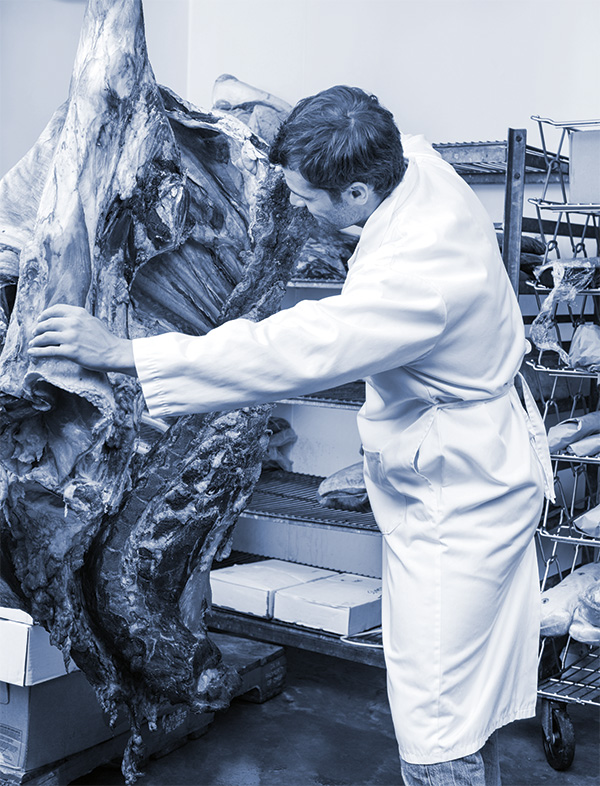
They are the guardians of the food production industry, yet few understand the role of the OPV. But, as Tracey Porter writes, plans are now afoot to allow these vets a chance to shine.Let’s be honest, as far as sexy career choices go, an abattoir monitor is probably not high on the list. In the court of public opinion, examining animals before and after slaughter to check for disease, certifying that the meat produced is suitable for human consumption and ensuring that staff maintain the highest standards of ethical, legal and safe practice is neither as exciting nor emotionally charged as witnessing Rover the retriever being brought back from the brink. Not that any of that mattered one jot to West Australian veterinarian Dr Samson Lui when he decided to become an OPV [on-plant veterinarian] in Esperance 18 months ago.A veterinary officer for the food service group at the Department of Agriculture, Dr Lui’s role as an OPV encompasses responsibility for the examination of animals at pre-slaughter to make sure they are fit and free from obvious disease and overall responsibility for hygiene in the abattoir. He must also ensure audit compliance with fit-to-load regulations and monitor that cohorts of animals are managed ethically pre-slaughter.In addition, once the carcass is on the chain it is the OPVs job to inspect it for signs of disease that may prevent the meat from entering the food chain.Dr Lui says he was drawn to a public health role as work as an OPV offered better job security, a higher rate of pay and more stable hours than had he becoming a vet in a private practice. Upon graduating two years ago, the 28-year-old initially spent four months working at the Australian Neuroscience Research Institute as a vet research assistant prior to accepting his role with the government department but now says public health is where he sees his future.He says it is immensely rewarding knowing he and his team have contributed to promoting food safety and Australian standards. “Speaking personally, working as an OPV cultivates my skills in leadership and management. It offers rewarding career prospects and the Department of Agriculture also offers opportunities and support for continuing education.”Having finished his studies at Perth’s Murdoch University in 2013, Dr Lui was one of the first graduates of a 12-week intensive course offered only to finalyear veterinary students eager to pursue a career in animal welfare, public health and food safety. Launched after the department identified a critical shortage of veterinarians motivated to undertake careers in this non-traditional type of veterinary practice, the course is run by the university’s School of Veterinary and Life Sciences College of Veterinary Medicine and is believed to be the only accredited provider in the country offering a qualification of this nature.To date, nine students have completed the course, which is funded by the department, with six going on to take up positions as OPVs, overseeing animal welfare and food safety in export abattoirs across the country. Three students are enrolled in the program in 2015, however it is understood other universities may be considering introducing a similar type of qualification.Murdoch University Senior Lecturer in Production Animal Health and Welfare, Dr Michael Lawrence, who leads the research, teaching and farm animal clinical services team, says the program gives students the opportunity to learn theory—namely the relevant legislation—and the key aspects of public health, food safety and animal welfare. He says it is by shadowing the OPVs at abattoirs that the student vets learn all the practical skills the job requires. Modules covered in the course range from knife sharpening and maintenance to auditing principles and export control legislation.“They are assessed by senior OPVs already working at abattoirs and senior department veterinary staff,” says Dr Lawrence. “The students finish the course qualified to work as an OPV following an induction into the department. The final part of the training is six months on-the-job experience after graduation.”He says this type of training offers a win/win solution for those involved. The department benefits greatly from a steady stream of OPVs to employ, aiding succession planning as more experienced vets currently in these roles near retirement. While for the students it offers expanded career opportunities. “The starting salary for these roles is generally higher than that of a vet going into a standard practice and the training is short circuited by months by having this opportunity while they are still students.”Agribusiness professional Ed Dunn, of the Food Division of the Department of Agriculture, says the program offers the chance to access veterinarians, who are inspection and regulation ready, to mitigate the problems of staff shortages in the future. “The meat industry will have the opportunity to draw on this resource also if markets begin to dema

Source: OPVs—at the coalface – Vet Practice Magazine

International Congress for Tropical Medicine and Malaria | 18- 22 September 2016, Brisbane, Australia

On behalf of the Congress Management Committee, the Australian Society for Parasitology (ASP) and the Australasian Society for Infectious Diseases (ASID), it is our immense pleasure to invite you to join us for the XIX International Congress for Tropical Medicine and Malaria (ICTMM 2016) in Brisbane. The Congress will be held at the Brisbane Convention & Exhibition Centre from Sunday 18th – Thursday 22nd September 2016.The Congress is an exciting opportunity for delegates to network and share knowledge in the areas of tropical medicine, malaria, parasitology, infectious diseases, zoonoses, veterinary health, travel medicine and more. The program will include international plenary speakers, oral presentations, posters, exhibition and social events.Brisbane provides a beautiful location for ICTMM 2016 with its picturesque winding river, attractive modern buildings, a thriving retail centre, excellent restaurants and most importantly – year-round pleasant weather. Brisbane is a diverse city with one of the fastest growing economies in Australia. It is a city of alluring character: from its distinctive architecture (the charming ‘Queenslanders’ and worker’s cottages that line inner-suburban streets) to its swimming beach right in the middle of the CBD.Be sure to join our mailing list below for Congress updates!We look forward to welcoming you to Brisbane.    Professor Malcolm JonesThe University of QueenslandAustralian Society for Parasitology   Dr David LookeInfection Management Services, Princess Alexander Hospitalrepresenting Professor Cheryl Jones,President, Australian Society for Infectious Diseases (ASID) Inc.

Source: International Congress for Tropical Medicine and Malaria | 18- 22 September 2016, Brisbane, Australia

Global Alliance for Rabies Control – free E-learning package

The GARC Education Platform has free online courses that will support your rabies prevention efforts. They can be studied online or downloaded to study offline. However, to receive the course certificate, the final assessment must be completed online.

The Rabies Educator Certificate (REC)

The REC course is open to everyone, but aimed specifically at people who work in at-risk communities and can address community education on rabies. These people may be health/veterinary/community workers, or key people within the communities in a position to provide others with accurate, life- saving information about rabies prevention.

The REC modules include:

  • What is rabies and how do people and animals get the disease
  • How to avoid dog bites and prevent rabies
  • Caring for animals
  • Understanding the role of a community educator in preventing dog bites and rabies
  • Communicating with people

This course is currently available in English, French and Spanish.

The Animal Handler and Vaccinator Education Certificate (AHVEC)

The AHVEC course builds on the REC and is an introduction to effective and humane dog handling and vaccination. Participants need to complete the Rabies Educator Certificate before accessing this course.

The AHVEC covers:

  • The role of the animal handler and vaccinator
  • Understanding animal behaviour
  • Effective ways to approach dogs
  • Equipment needed to catch and handle dogs
  • Effective vaccine administration techniques.

The AHVEC course should be followed by physical training under the guided supervision of a professional and is also suitable for trained professionals who wish to refresh their knowledge and remain up-to-date regarding new techniques and tools on dog handling and vaccination.

This course is currently available in English.

Source: GARC Education Platform: Log in to the site